Hardest PA Schools to Get Into? What Selective Programs Actually Report
Penn State is a documented example of a highly selective PA school: it offered admission to 42 applicants from 3,623 applications for its Class of 2028, about 1.16%. Duke, East Carolina and Utah Valley publish other pieces of the admissions process. Those figures show where competition occurs, but they do not establish a national ranking of the hardest PA schools to get into. Penn State PA class profiles
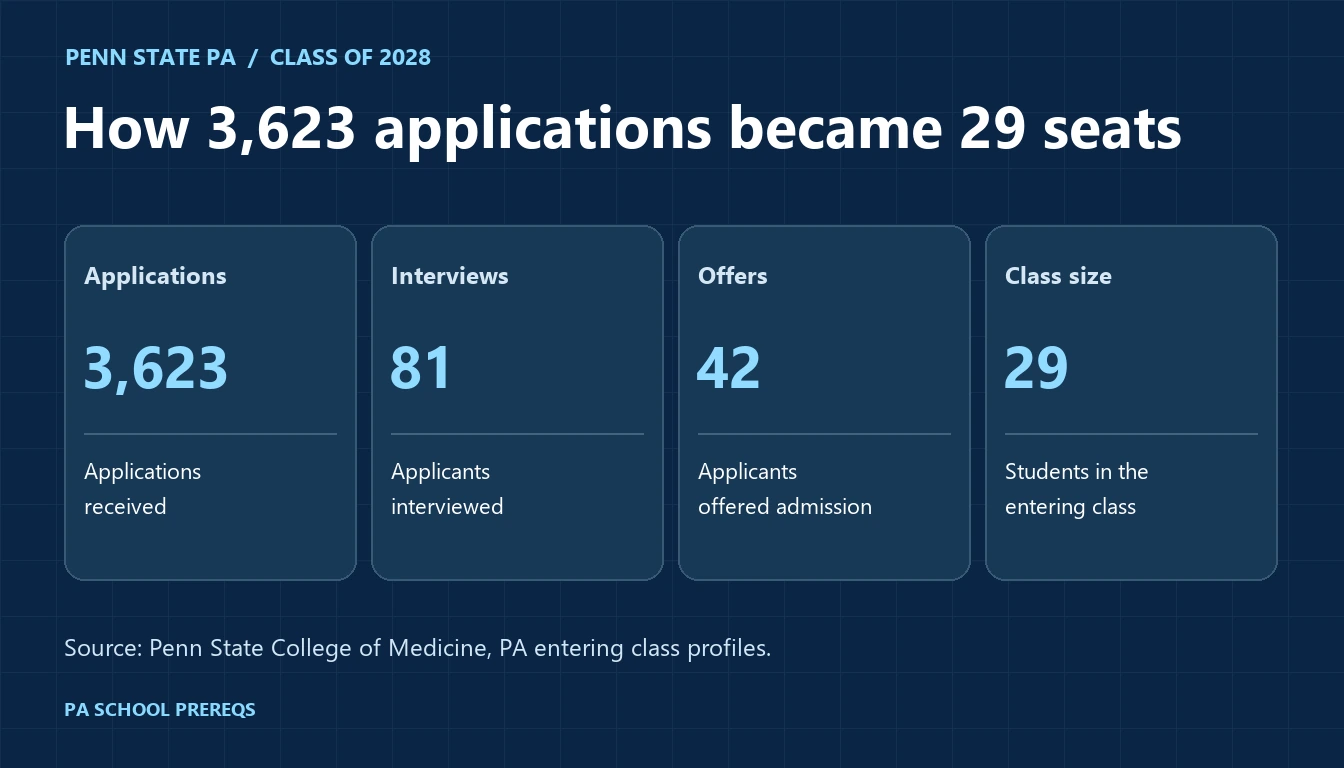
Penn State: a PA school that publishes an actual offer count
In its Class of 2028 profile, Penn State reports 3,623 applications received, 81 interviews, 42 applicants offered admission, and a class of 29. Because the school identifies each group, you can answer three different questions without guessing what a column means. Penn State, Class of 2028 facts and figures
| Question | Calculation | Result |
|---|---|---|
| What share of applications led to interviews? | 81 ÷ 3,623 | 2.24% |
| What share received admission offers? | 42 ÷ 3,623 | 1.16% |
| How large was the enrolled class relative to the pool? | 29 ÷ 3,623 | 0.80% |
If a list calls this a 0.80% acceptance rate, it has effectively erased 13 people who were offered a place. Penn State’s Class of 2026 shows why the distinction holds across years: 47 offers from 4,611 applications, or about 1.02%, for a class of 30. Use the school’s class labels when citing these numbers. “Class of 2028” identifies a cohort, not an application cycle that happened in 2028. Penn State historical class profiles
Duke: how much the applicant pool changes before interview
Duke’s FAQ reports 2,928 verified CASPA applications and 1,619 valid applications for its 2025 incoming class, with approximately 250 applicants interviewed. That is roughly 9% of the verified pool or 15% of the valid pool who interviewed. Both calculations use the same interview group. Changing the denominator changes the answer. The FAQ separately describes people who accepted an offer for the fall 2026 entering class. Combining that later figure with the earlier application pool would mix cohorts as well as outcomes. Duke PA admissions FAQ
The useful question for a prospective applicant comes earlier than the interview: what makes a CASPA application valid for this program? Before paying, put the application instructions next to your transcript, experience record and deadline. An application service marking your file verified does not establish that a program considers every required item complete.
East Carolina and Utah Valley: two ways a reach list can mislead
East Carolina reports more than 1,000 applications annually and approximately 120 applicants selected for interview. Its FAQ also lists the states and Washington, DC from which it accepts residents. Check that rule first. If you live outside the listed area, the interview count says little about your decision. If you meet the residency rule, the FAQ still gives you an interview count rather than the number of people offered admission. East Carolina PA admissions FAQ
Utah Valley describes making initial offers to the top 30 candidates after interviews and ranking alternates. That tells you how its first round of decisions works. It does not tell you how many offers it will ultimately take to fill the class if some applicants decline. A waitlisted applicant has a different question from someone deciding whether to apply: how does the school communicate updates, and what deadline applies to another offer already in hand? Utah Valley interview and admission decisions
When is a highly selective PA school worth an application?
Imagine two programs with similar class sizes. One has a low published offer rate, but you meet every required course and its clinical training fits the population you hope to serve. The other has no published offer count and requires a course you cannot finish by its deadline. A missing acceptance rate at the second school does not make it the safer use of your fee. The first may be a reasonable reach if you can explain the fit and still afford to apply to other eligible programs.
Choose your next step according to where the uncertainty lies. If the eligibility question is academic, compare your GPAs with one PA program and read the program’s own course rules. If you already have an interview invitation, stop using the overall applicant pool as your benchmark. Use the school’s interview format to practice describing one patient-care decision and one instance of teamwork. The PA school interview questions guide gives you prompts to practice aloud.
When you record a reach, keep the class year, the source, the two counts and the decision they inform. “42 offers from 3,623 applications” can guide how much risk to take across a shortlist. It cannot tell you whether your individual application has a 1.16% chance. Revisit the list if a prerequisite, a deadline or the cost of attending changes.
Check your academic fit at one school for free. Use the paid Dashboard to compare requirements, save questions for admissions and practice your interview answers.
Try the free Chances calculatorSee the Application Dashboard and compare access options.
Frequently asked questions
Is the PA school with the smallest class the hardest to enter?
A class of 30 can require more than 30 offers to fill. To compare admissions selectivity, look for offers and applications from one cohort, then check how each school defines an application.
What was Penn State’s PA school acceptance rate?
Penn State reports 42 applicants offered admission from 3,623 applications for the Class of 2028. That is an offer rate of about 1.16%. The enrolled class had 29 students.