CASPA 2026-27 is open - rolling programs fill early Day-one timeline →

Your PA application prep, in one place. Explore 339 listings. Build your shortlist.

Map your transcript and see your CASPA-style GPAs. Compare prerequisites across your shortlist, preview which gaps next semester could address, and keep admissions answers beside the requirements they clarify. Your next steps stay in view, from course planning to application deadlines. Compare programs and rank your saved shortlist yourself.

Prepaid 3, 6, or 12-month terms. No auto-renew. A spreadsheet-only option is available inside the offer below.

Why this exists

Every applicant rebuilds the same research from scratch.

Program data is scattered

339 listings, 339 different ways of publishing GPA minimums, prereqs, deadlines, and CASPer policy. Nothing is standardized.

The work is spread across tabs

A deadline in one tab, a school-specific essay in another, hours in a notebook, and letter requests in your inbox. Keep the next step visible for every application.

Advice ages badly

Most guidance you find is several cycles stale. Async video interviews are standard now, and requirements move every year.

New in the Dashboard · Included with every term

Know what is missing. Plan what comes next.

01 / Prerequisite matrix

See the gaps across your shortlist.

Compare mapped course requirements for up to six saved programs at a time. See what meets a mapped rule, what is missing, and what needs verification, with course details and source links close at hand.

02 / Next semester planner

Give each planned course a purpose.

Save a proposed course list and preview which prerequisite gaps it could address across your saved schools. Explore your next semester while keeping planned courses separate from your completed transcript and GPA.

03 / Verification workspace

Keep the answer, not just the question.

Prepare a question for admissions, save the reply and its source, and set a follow-up date. Keep personal confirmations beside the requirement they clarify, with prompts to recheck when relevant rules or completed courses change.

04 / Smarter next steps

Open your dashboard with a direction.

See suggested actions based on your application stage, upcoming deadlines, prerequisite gaps, saved semester plan, and verification follow-ups. Pick up where you left off as your preparation progresses.

A clearer plan, with the details kept honest: mapped matches are not an admissions decision. Confirm course age, online-course acceptance, and completion deadlines with each program. Personal confirmations stay separate from published policies.

See access options
02 / Get Access The Application Dashboard

Build your school list. Keep each application moving.

Start with transcript mapping, CASPA-style GPAs, and program matching across 339 listings. Use the prerequisite matrix to spot gaps, plan next semester, and keep admissions confirmations organized. Then track applications, deadlines, essays, hours, and recommenders through the cycle.

3 months
$48
$16/mo · paid once
Focused preparation Enough runway to map your transcript, build the list, and get your file ready to submit.
Get 3 months
Best value
12 months
$120
$10/mo · paid once
A cycle, start to finish A full year for prerequisite planning, application preparation, and interview practice.
Get 12 months
Every term includes all Dashboard workspaces, the spreadsheet, and 2 Transcript Mapper runs. Includes 3 statement reviews with 3 months, 6 with 6 months, or 12 with 12 months. Credits are granted once per purchase, not monthly. One payment · does not auto-renew · instant access.
Included with every term

Your school list, drafts, and next steps. Together.

Every term includes the prerequisite matrix, semester planner, verification workspace, and personalized next steps, alongside all the application tools below and the downloadable spreadsheet.

Application tracker

Track each program and cycle with statuses, checklists, notes, and interview dates. See upcoming and overdue tasks, add personal targets, export an all-day calendar, and archive or restore past applications.

Supplemental essay workspace

Keep multiple prompts per application, follow word or character limits, and autosave drafts. Export or copy a draft to another school and save a submission snapshot that stays intact when you revise.

Side-by-side program comparison

Compare two to four ranked programs with your GPA and experience in view. Choose fields for tuition, deadlines, accreditation, tests, and missing prerequisites, with source links and unknown data labeled.

Transcript Mapper

Upload your transcripts once. Get CASPA-style cumulative, science, non-science, and last-60 GPAs, with every course mapped to its CASPA subject.

Qualified program list

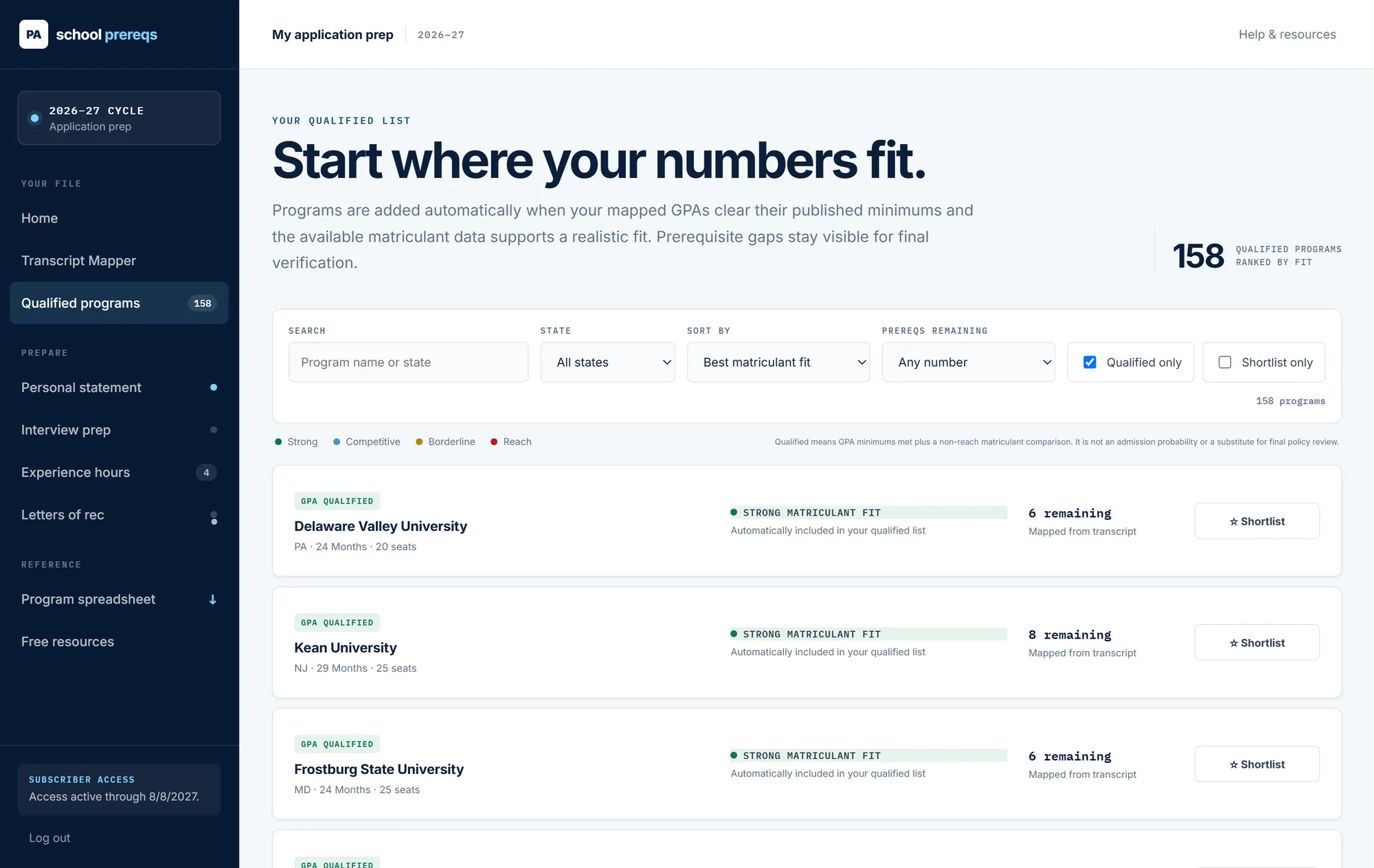
Explore 339 listings, check published GPA minimums and remaining prerequisites, and rank your saved programs yourself. Prior-cohort comparisons provide context, not an admission probability.

Personal statement workspace

Draft against the CASPA character limit with the four-part structure beside you, then run the six-dimension checker when it is ready.

Interview prep

22 questions programs actually ask, the PIVOT framework for answering them, a practice timer, and answers that save as you build them.

Experience records & exports Expanded

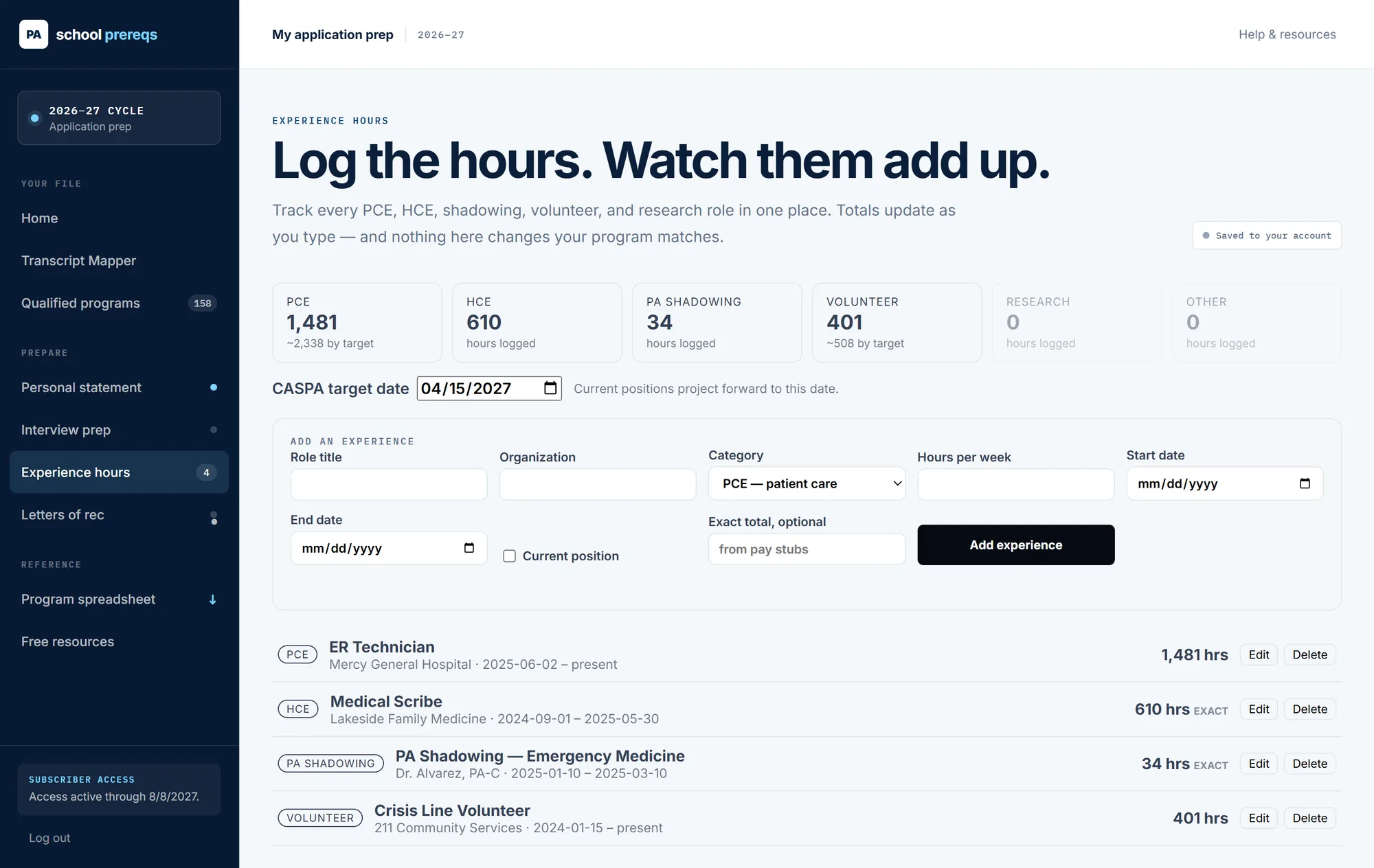
Log PCE, HCE, shadowing, volunteer, and research roles with supervisor details and responsibilities. Copy or download a preparation packet with completed hours, estimates, and projections clearly separated.

Recommender tracking Expanded

Keep a roster of recommenders, update request statuses and dates, and use personalized request, reminder, and thank-you templates for professors, clinical supervisors, and employers.

Program list with published requirements, prerequisite counts, and saved programs
Your program list - 339 listings, published requirements, and a shortlist you rank yourself.
The experience hours tracker: per-category totals for PCE, HCE, shadowing and volunteer hours, with a CASPA target date projection
Every hour in one place - PCE, HCE, and shadowing totals, projected forward to your CASPA date.
The Program Spreadsheet is included too - 339 listings, 50 columns, yours to download and keep. Applicants who only need the file can choose the spreadsheet-only option below.
Recommended · Application Dashboard

Use the full Dashboard, unless the raw file is truly all you need.

Dashboard access maps your transcript, compares prerequisites across your shortlist, previews next-semester courses, and keeps admissions confirmations and next steps organized. It also brings applications, deadlines, essays, experience records, and recommenders together. Personal statement tools and interview prep are included, along with the same 339-listing spreadsheet as a download.

Compare Dashboard terms - from $48
Spreadsheet only
$24.99
One-time · instant delivery · Excel or Google Sheets
Buy only the spreadsheet
6 tabs · prereqs, matriculant data, tuition · ranking tool · verified quarterly
PA_School_Prerequisites.xlsx
Program State Min cGPA Min sGPA GRE CASPer PCE hrs LORs Gen Chem Org Chem A&P Micro Statistics Deadline
Duke University Medical CenterNCN/AN/ARequiredNot Required100038 Credit(s), Lab Required-3 Credit(s) / 3 Credit(s)3 Credit(s)3 Credit(s)09/01/2026
Emory UniversityGA3.003.00Not RequiredNot Required200028 Credit(s), Lab Required (two chemistry courses)Organic Chemistry OR Biochemistry: 3 Credit(s)Accepted: 6 semester / 8 quarter credits totalRecommended but not required3 Credit(s)06/15/2026 (closed; see note)
Stanford UniversityCAN/AN/ANot RequiredNot RequiredN/A2--- / ---07/15/2026
Loma Linda UniversityCA3.003.00Not RequiredNot Required200038 Credit(s), Lab Required-Combined Human Anatomy and Physiology sequence accepted4 Credit(s), Lab Required-10/01/2026
University of IowaIA3.003.40Not RequiredNot Required100038 Credit(s)3 Credit(s)- / 3 Credit(s)-3 Credit(s)10/01/2026
Samford UniversityAL3.003.00RequiredNot RequiredN/A38 Credit(s), Lab Required-4 Credit(s), Lab Required / 4 Credit(s), Lab Required4 Credit(s), Lab Required3 Credit(s)08/01/2026

Published cycle dates are retained after closing. Emory deadline note: official school page June 15, 2026; PAEA July 15, 2026. The 2026 cycle is closed; the next deadline is unconfirmed.

Free, no account

Start with the free tools.

Who made this
Dominick Tumacder, PA-C, RRT
Founder · PAschoolprereqs.com
Read the full about page →

I am a practicing Physician Assistant in the Neuro ICU. Before PA school I served as a U.S. Army practical nurse, then spent fifteen years as a respiratory therapist in adult acute care.

It took me three application cycles to get in: one program the first time, then three, then twenty-two. The spreadsheet at the center of this site started during that third cycle, so I could keep hundreds of requirements straight. I shared it with the pre-PA community on Reddit, where it has lived for five years. The Dashboard is that same research habit, built into something that does the work for you.
Frequently searched

PA school prerequisites, explained.

What does ARC-PA accreditation mean? +
The Accreditation Review Commission on Education for the Physician Assistant (ARC-PA) is the only recognized accrediting body for U.S. PA programs. The August 13, 2026 ARC-PA baseline lists 330 accredited entry-level sponsoring programs across three accreditation categories: Continuing, Provisional, and Probation. Graduating from an accredited program is required to sit for the PANCE - the national certification exam - and to practice as a PA. The PAschoolprereqs spreadsheet includes every program in all three categories and labels the status explicitly so you can weigh risk before applying.
What are the typical PA school prerequisites? +
Most programs expect prerequisite coursework in anatomy, physiology, microbiology, general and organic chemistry, biochemistry, general biology, statistics, and psychology. Many also require medical terminology and some version of a human behavior or developmental psychology course. Minimums typically sit around a 3.0 overall GPA and 3.0 science GPA, but competitive applicants usually present a 3.5+. Individual programs vary significantly - some require genetics, some require specific lab components, and a growing number accept pass/fail pandemic-era courses only conditionally. The spreadsheet spells out the exact requirement for every program in a single filterable column set.
How many PCE hours do I need for PA school? +
Patient Care Experience (PCE) hour requirements vary widely - from 0 hours at a handful of programs to 4,000+ hours at the most experience-heavy programs. The median is around 1,000–2,000 hours of direct, hands-on patient care. What counts as PCE also varies: most programs accept CNA, EMT, medical assistant, phlebotomist, scribe (sometimes), ER tech, and paramedic hours. Shadowing is almost never counted as PCE and is tracked in a separate bucket (usually 20–100 hours). Every program's exact PCE requirement, accepted roles, and hour ceiling is listed in the spreadsheet.
What is CASPA and when does it open? +
CASPA (the Centralized Application Service for Physician Assistants) is the one online portal used to apply to almost every U.S. PA program. It opens April 30, 2026 for the 2026-27 cycle. Most programs use rolling admissions, which means the earlier you submit a verified application, the better your odds - the practical Golden Goal is June 1. For the full month-by-month cycle plan, read the CASPA 2026-27 Application Timeline. The split between rolling and non-rolling programs is covered in the rolling admissions deep-dive. The spreadsheet lists each program's CASPA deadline, review style, and supplemental fee so you can sequence submissions by risk and cost.
How is PA school different from medical school? +
PA training is a master's-level program, typically 24–28 months, combining ~12 months of didactic coursework with ~12–16 months of rotations. Medical school is a four-year doctoral program followed by 3–7 years of residency. PAs practice under a collaborative agreement with a physician but can diagnose, prescribe, and perform procedures; they also move laterally across specialties without re-credentialing, which is one of the defining features of the role. For applicants, the admissions calculus differs too: PA programs weigh PCE, CASPer, and interview fit more heavily than MCAT-style numeric cutoffs.
How competitive is PA school really? +
Based on the most recent CASPA cycle, roughly 34,625 applicants competed for 12,636 seats - a 36% match rate across all programs. Program-level acceptance is often far lower (sub-10%). Competitive applicants present a science GPA at or above 3.5, 2,000+ PCE hours, strong CASPer scores where applicable, and a personal statement that reflects a specific, adult understanding of the PA role. The Pre-PA Playbook walks through each of these variables in detail. For the full PAEA 2024-25 numbers, read the applicant statistics breakdown.
Questions

Frequently asked.

What is the Application Dashboard? +
It is one workspace for PA application preparation: map your transcripts, calculate CASPA-style GPAs, compare programs and prerequisites, plan your next semester, and save admissions confirmations. Personalized next steps help you keep applications, deadlines, essays, experience records, and recommenders moving. Personal statement tools, interview prep, and the full spreadsheet download are also included.
Will planned courses change my transcript or GPA? +
No. The next semester planner previews potential prerequisite coverage. Planned courses stay separate from your completed transcript, GPA calculations, and program rankings. Confirm course age, online-course acceptance, and completion deadlines directly with each program.
Does a matched prerequisite or saved confirmation guarantee eligibility? +
No. The matrix checks mapped course rules and labels missing, uncertain, or unassessed requirements. A saved admissions reply is your personal evidence; it does not rewrite published policies or change the automated match. Programs make the final eligibility and admissions decisions.
Does the Dashboard submit applications or send recommendation requests? +
No. Track your progress in the Dashboard, then submit applications through CASPA or the program. Recommender statuses are updated manually. Templates help you prepare emails to send yourself; the Dashboard does not send them or collect confidential letters.
Do supplemental essays use personal statement review credits? +
No. The supplemental essay workspace is for writing, saving, copying, and exporting your drafts. It includes word and character counts and saved submission snapshots. It does not grade essays or use personal statement review credits.
Is the Dashboard a subscription? +
No. You buy a prepaid term - 3 months for $48, 6 for $84, or 12 for $120 - with a single payment. It does not auto-renew and there is nothing to cancel. When your term ends, access ends; your data follows the deletion policy in the privacy policy.
Should I buy the Dashboard or just the spreadsheet? +
Choose the Dashboard for transcript mapping, program and prerequisite comparison, semester planning, admissions verification, and personalized next steps, plus one place to track applications, deadlines, essays, experience records, and recommenders. The spreadsheet is included with every Dashboard term. Choose the $24.99 spreadsheet-only option only if you want the raw 339-listing, 50-column file and plan to do the comparison work yourself.
What format is the spreadsheet? +
A .xlsx file that opens natively in Microsoft Excel, Apple Numbers, and Google Sheets - no subscription required. Standalone purchases deliver instantly via Stripe with a download link emailed to the address used at checkout; Dashboard subscribers can download it any time from inside the Dashboard.
How is the data kept current? +
PAEA program data was refreshed in October 2026. Accreditation uses the August 13, 2026 ARC-PA baseline, with new applicant-facing listings checked in October. Requirements are reviewed on a rolling basis, and applicants should verify time-critical details directly before applying.
How many programs are covered? +
The product covers 339 applicant-facing PAEA/CASPA listings. ARC-PA separately lists 330 accredited sponsoring programs; the directory also preserves separately listed campuses and pathways plus ten applicant programs that are not currently accredited.
I bought the Interview Guide, a bundle, or the Personal Statement Checker before. What happens to it? +
Everything you purchased keeps working - delivered files stay delivered, and Personal Statement Checker sessions remain usable. Those products are no longer sold separately because their successors live inside the Dashboard, but nothing you bought goes away.
Are there refunds? +
No refunds after download or after Dashboard access begins. Data accuracy issues and broken links can be reported to [email protected] and are fixed on priority.
Can I share my account or files with friends? +
Purchases and Dashboard access are for personal use. Please don't redistribute - real time goes into keeping the data current. Send friends to paschoolprereqs.com instead.
Stop compiling, start applying

One dashboard. Every step before submit.

Compare prerequisites, plan your next courses, and keep admissions answers and application deadlines together. One prepaid term includes every Dashboard workspace and the spreadsheet, with no auto-renew.